Why we build DX as a web-native desktop app: A conversation with CEO Andrew Gasparovic
Fast-loading pages and a buttery-smooth user experience

Flight Science DX is the first integrated platform designed for dispatchers, with dispatchers. DX is currently in design partnership with a large US airline and will be available this Fall.
Why did you build DX as an installed desktop app rather than a standard web app?
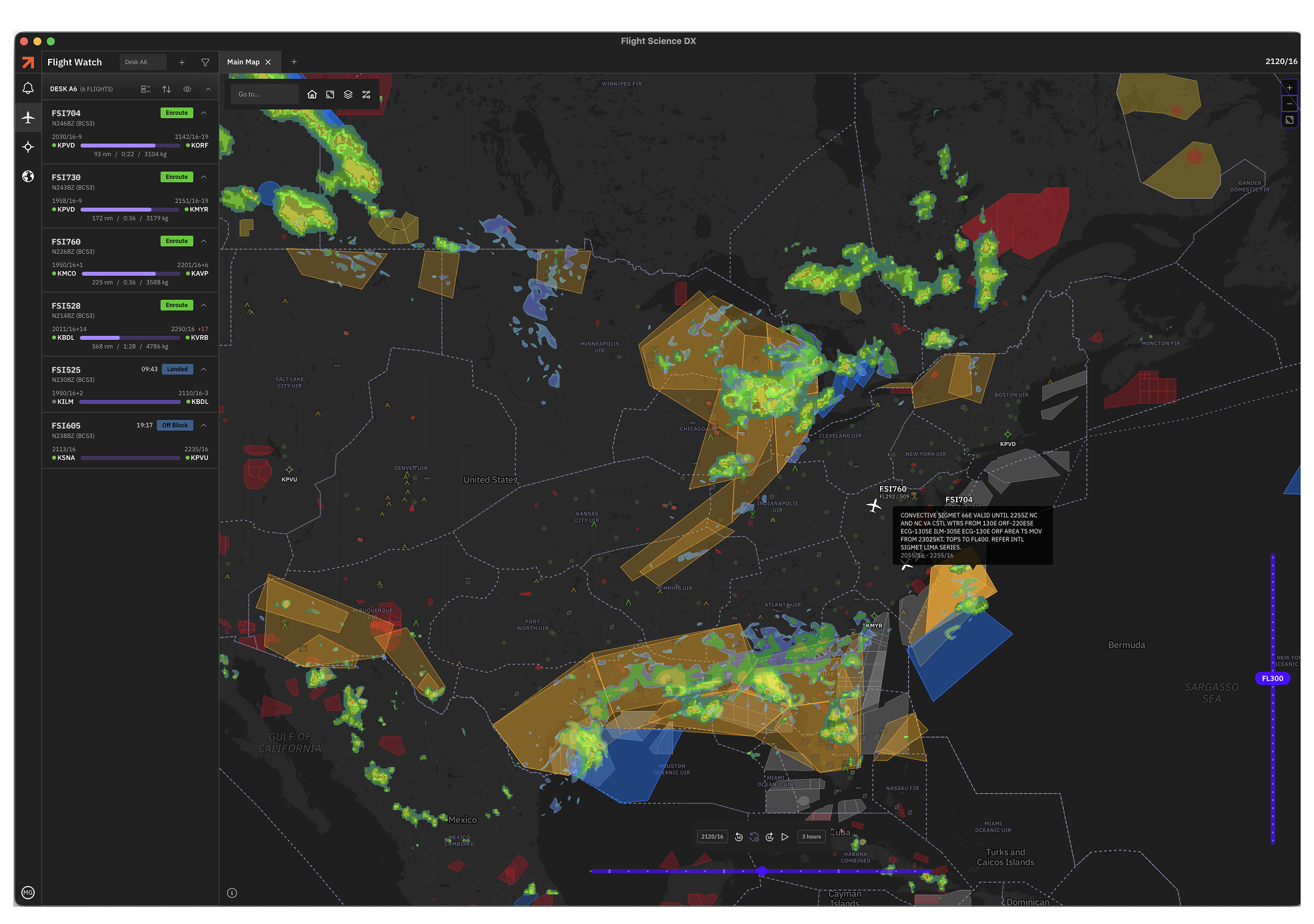
Because dispatching is graphics-intensive work, and that's core to what DX does. Weather layers, airspace, flight tracking, and surface tracking all render together, updating every couple of seconds, and look great while they do it. You can drag the Timeline Slider to see weather and aircraft movement, minute by minute, up to 12 hours ahead. That's an enormous amount of continuous rendering, and a browser tab can't get close enough to the hardware to do it justice. Building DX as a web-native desktop app lets us go straight to the GPU and use the full capabilities of the machine, while still building on modern web technology. So we get native performance without giving up the speed and consistency of a web codebase.
Was that always the plan, or did something change your mind along the way?
It was there from the very beginning. I knew this had to be powerful: GPU-accelerated, with direct access to the graphics processor, preloading weather data intelligently and keeping it warm and running continuously. That points to a desktop app. It also gives us real multi-monitor support — dispatchers can pull tabs into separate windows across multiple monitors and keep everything organized, which a browser can't do cleanly.
What would a dispatcher notice as different?
Performance. Pages load instantly, and panning around the map is buttery smooth even with every layer enabled. Dispatchers spend several hours a day in this tool, so that fluidity is the difference between fighting your tools and forgetting they’re there. We built DX with dispatchers, for dispatchers.
What about questions from IT?
On the machine, DX needs no special permissions and doesn’t touch anything beyond its own map cache. No other files or special app permissions – it’s self-contained, with a narrow, well-defined footprint. On the backend, everything runs on AWS with the cloud-native reliability and security features like encryption in transit and at rest that an airline would expect.
Were there any trade-offs going this route?
Two things we address head-on. First, most vendors have moved to web apps, so an airline may be surprised we didn't. We explain the reasoning up front: moving to a web app means giving up performance to simplify deployment, and the dispatcher is the one who feels it. We found a way not to make that trade. Second is IT management, and here because DX is cloud-connected, it's just as easy to manage and update as a web app. There's no customer-maintained infrastructure or manual patching, and we have standard integration for single sign-on.
That's the key distinction. The old generation of dispatch desktop software was genuinely hard to manage and updates were painful. So the legacy providers are moving to web apps to escape that. But DX gives you the cloud-native manageability of a web app and the performance only a native app can deliver.

What about updates — are those automatic?
Yes. There's no heavy release or patching cycle — updates are automatic, regular, and frequent, each bringing performance and reliability improvements behind the scenes. Major new features aren't tied to a release. The airline enables or disables them through the Admin Console on its own timeline. The app stays continuously current, and the airline stays in control of when new capabilities reach dispatchers.
Does building a real app open up anything a year or two out that a web app couldn't?
Yes, and this is the part I’m most excited about. Since DX is a web-native desktop app, we can extend it into an EFB app running natively on the iPad, and into a mobile app with alerts for ground staff — all sharing the same code and UI across desktop, tablet, and phone. There’s no path to this from a web app; an EFB has to run natively on the iPad. And that shared foundation is exactly what airlines are looking for: a flight-monitoring app and an EFB that let dispatchers and pilots share the same big picture. We built DX this way from day one so it can be the best possible tool for dispatchers today, as well as the foundation of a whole suite of products across operations tomorrow.
Andrew Gasparovic is the CEO of Flight Science. He started Flight Science in 2024 to make tools that dispatch and airline operations love to use. Click here to learn more about DX.

Michelle Gasparovic is a Product Marketing Manager at Flight Science.